


Walk through any electrical project in the United States and you will see it everywhere: a small circular mark printed on cables, enclosures, chargers and control panels, usually accompanied by a file number like "E123456." That mark is the UL Mark, and it is one of the most recognized symbols of product safety in the world.
For buyers and importers — especially in the fire alarm, security and electrical industries — UL certification is often the difference between a product that sails through inspection and one that gets rejected on site. This article explains what UL certification actually is, how it works, what the different marks mean, and how you can verify that a supplier's certification is genuine.
UL — originally Underwriters Laboratories, and today part of UL Solutions — is an independent, third-party testing and certification organization that has been evaluating product safety for more than a century. Billions of products around the world carry UL marks attesting that they have been tested against recognized safety standards.
One point is often misunderstood: UL is not a government regulator. In the United States, product safety is not pre-approved by a government agency. Instead, manufacturers must demonstrate compliance through recognized third-party testing organizations — known as Nationally Recognized Testing Laboratories (NRTLs) under the U.S. OSHA program — and UL is the best known of them. Codes such as the National Electrical Code (NEC), insurance companies and project specifications then reference those listings to make sure only tested, compliant products go into buildings.
When a product is UL certified, it means:
Every genuine UL Mark carries identifying information for traceability. In most cases it includes a unique file number — the letter E followed by six digits — that links the product back to the manufacturer's certification record. A manufacturer may hold different file numbers for different certification categories.
For fire alarm cable, the mark you normally want is UL Listed, with the cable type printed in the jacket legend.
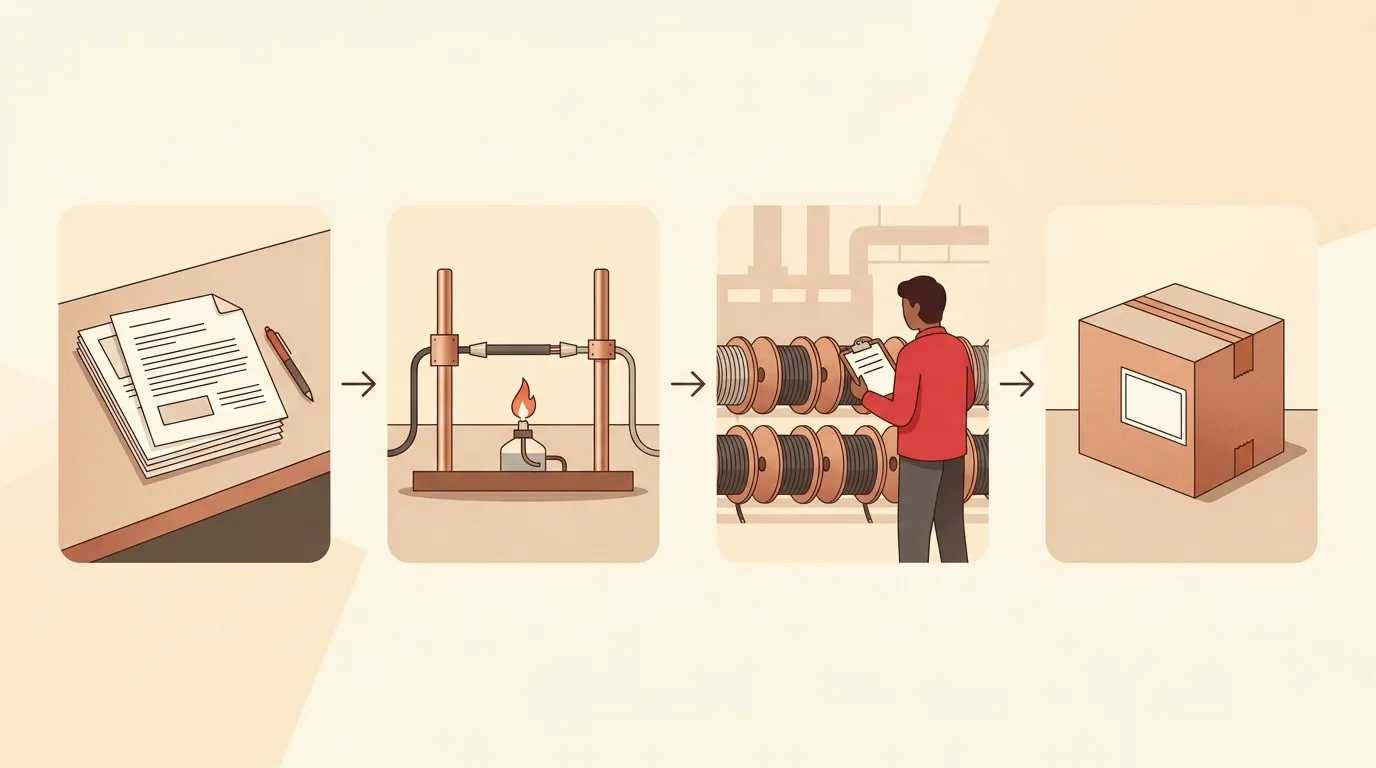
The path to the UL Mark is a four-stage process, and — critically — it does not end when the product leaves the laboratory.
The manufacturer selects the applicable standard(s) with UL engineers, submits product samples, construction details and documentation, and agrees on the test program.
Representative samples are tested in UL laboratories against the standard's requirements — for cables, that means fire and flame tests, electrical tests (voltage, insulation resistance), and mechanical tests, depending on the cable type.
Test data is evaluated against the standard. If the product passes, UL authorizes the manufacturer to apply the UL Mark to certified products and issues the certification record (with the E-file number).
This is what makes a UL listing different from a one-time test report. UL operates an ongoing Follow-Up Services program of onsite factory inspections and audits at the locations authorized to manufacture and mark the product. Inspectors confirm that the products being made are the same as those evaluated, verify that materials and components (e.g. UL Listed or Recognized components) match the approved construction, and check marking and traceability. The program begins with an Initial Production Inspection and continues for the life of the certification — so "certified" is a status that must be maintained, not a sticker that lasts forever.
UL certification is not just a nice-to-have for fire alarm cable — in North America it is written into the code. Fire alarm wiring is governed by NEC (NFPA 70) Article 760, which requires fire alarm circuits to use listed cable types:
These cable types are tested to UL 1424, the Standard for Power-Limited Fire Alarm Cable, which covers fire-resistance and flame-propagation requirements. For circuit-integrity applications that must keep working through a fire (the North American cousin of enhanced fire-resistant cable), UL 2196 covers fire-resistive cable tested for continued circuit operation — for example two-hour ratings for critical circuits.
A genuine UL Listed fire alarm cable carries a printed jacket legend with the cable type (e.g. "FPLR"), the UL mark and the manufacturer's file number — this legend is what inspectors look for on site.
The key contrast: UL (and ETL/CSA) marks are issued by an independent body that also keeps inspecting the factory; a CE marking is declared by the manufacturer itself. For U.S. projects, always ask for the actual third-party listing rather than accepting "CE approved" as an equivalent.
Anyone can verify a UL listing in minutes — and you should, before placing an order:
Red flags to watch for: a mark without any file number; a supplier who cannot produce a file number; a file number that does not resolve in Product iQ; or a listing that covers a different product category than the one being offered. Counterfeit and "self-printed" marks exist — the database is the only reliable source of truth.
Q: Is UL certification legally mandatory? A: The U.S. government does not pre-test products, so UL certification is not a blanket legal requirement. But it becomes effectively mandatory wherever codes (such as the NEC), insurance policies or project specifications require listed products — which covers most commercial electrical and fire alarm installations.
Q: What is the difference between UL Listed and UL Recognized? A: UL Listed applies to complete, finished products ready for end use. UL Recognized applies to individual components that will be installed inside a larger UL Listed system (for example a circuit board inside a control panel).
Q: How long does UL certification take? A: It varies widely by product category, standard complexity and laboratory schedules. Your certification body will provide a project-specific estimate — plan for a multi-month program for cable certification, including sample testing and the initial factory inspection.
Q: Does UL certification expire? A: A listing is maintained, not granted forever. It stays valid while the product continues to meet the certification requirements under the Follow-Up Services inspection program — and can be affected if the manufacturer fails to maintain compliance.
Q: Can I check a UL mark myself? A: Yes. Enter the file number into UL Product iQ and confirm the company name, product category and current status match what you were told.
UL certification is independent, standards-based and — above all — continuous: a product earns the mark through laboratory testing, then keeps it only while ongoing factory inspections confirm it still meets the requirements. For fire alarm cable, that means a listed product type (FPL, FPLR or FPLP per NEC Article 760, tested to UL 1424) produced under surveillance, identifiable by its printed legend and file number. For buyers, the practical takeaway is simple: ask for the E-file number, verify it in UL Product iQ, and never accept a mark you cannot trace.
Ningbo Hongxun Cable Co., Ltd. is a professional manufacturer of fire alarm and communication cables, holding UL certification (UL File No. E528992) with LSZH and fire-resistant options. For datasheets, samples or quotations, contact our sales team.
 PH30 Red 2 Core Solid Fire Ala
 PH30 Red 2 Core Stranded Fire
  8 Core Stranded Shielded Secur
 Red Single Core 4mm 6mm 10mm S
 RVVP Power Cable
 2 Core Solid Blasting Cable
 Red and Transparent Flat Speak
 Flat 6 CoreTelephone Cable
 Flat 4 CoreTelephone Cable
 3mm double core steel nose wir
 Cat5E UTP Patch Cord
 Cat6 FTP Patch Cord