Fire alarm cable is a life-safety component. Unlike ordinary wiring, it must not only carry signals reliably every day — it must keep working while a building burns. Choose the wrong cable and you face two possible failures: a system that fails inspection today, or a system that goes silent in a fire tomorrow. Neither is acceptable.

Choosing the right fire alarm cable is not complicated once you follow a logical sequence. Work through these five questions in order, and you will land on the correct specification every time:
- Which standard applies to my project?
- What fire-resistance grade does the building need?
- What construction do the circuits require?
- Where and how will the cable be installed?
- Is the cable genuinely certified?
01 — Start with the Applicable Standard
Fire alarm cabling is defined by the codes and standards of the destination market. The standard tells you the minimum the cable must do, so identify it first:
If your customer's project references BS 5839-1, the cable must be fire-resistant, standard or enhanced grade, with copper conductors of at least 1 mm² and — in most cases — a red sheath. If it references the NEC, the cable must be a UL Listed FPL-family type. Standards are not interchangeable: always match the cable to the standard named in the specification.
02 — Decide the Fire-Resistance Grade
The most important technical decision is the fire-resistance grade, because it defines how long the circuit must survive a fire (typically tested at about 830°C with mechanical shock per BS EN 50200).
Rule of thumb: if the design specifies standard-grade fire alarm cable (PH30) and the building is a typical commercial or residential project, standard grade is correct — there is no need to over-specify. Choose enhanced grade when the fire strategy, insurer or local code demands longer circuit survival, or when the building's evacuation time is long. Note also that in the United States the equivalent decision is between FPL (general), FPLR (riser) and FPLP (plenum) types under UL 1424, with UL 2196 fire-resistive cable for circuits that must keep operating through a fire.
03 — Specify the Right Construction
Once the grade is fixed, the construction details follow from the circuits and the environment.
Cores and conductor size
- 2-core — simple detector loops and basic circuits.
- 3-core / 4-core — networked systems, sounder circuits and installations needing a common return or extra cores.
- Conductor size — BS 5839 requires at least 1.0 mm²; 1.5 mm² is the most common choice. On long loops, check voltage drop and loop impedance — low-impedance cable keeps signals reliable over distance.
Screened or unscreened?
- Unscreened cable is the standard choice for normal, low-interference environments.
- Screened (shielded) cable should be used when the fire alarm cable runs near power cables or other wiring, or in areas with high electromagnetic interference (EMI) — screens protect the signal circuits from induced noise that could cause false alarms or missed events.
Sheath material and colour
- LSZH (Low Smoke Zero Halogen) sheaths emit minimal smoke and very low acid gas in a fire — they keep escape routes visible and reduce corrosion of nearby equipment. Verify compliance with EN/IEC 60754-1 (acid gas) and EN/IEC 61034-2 (smoke density).
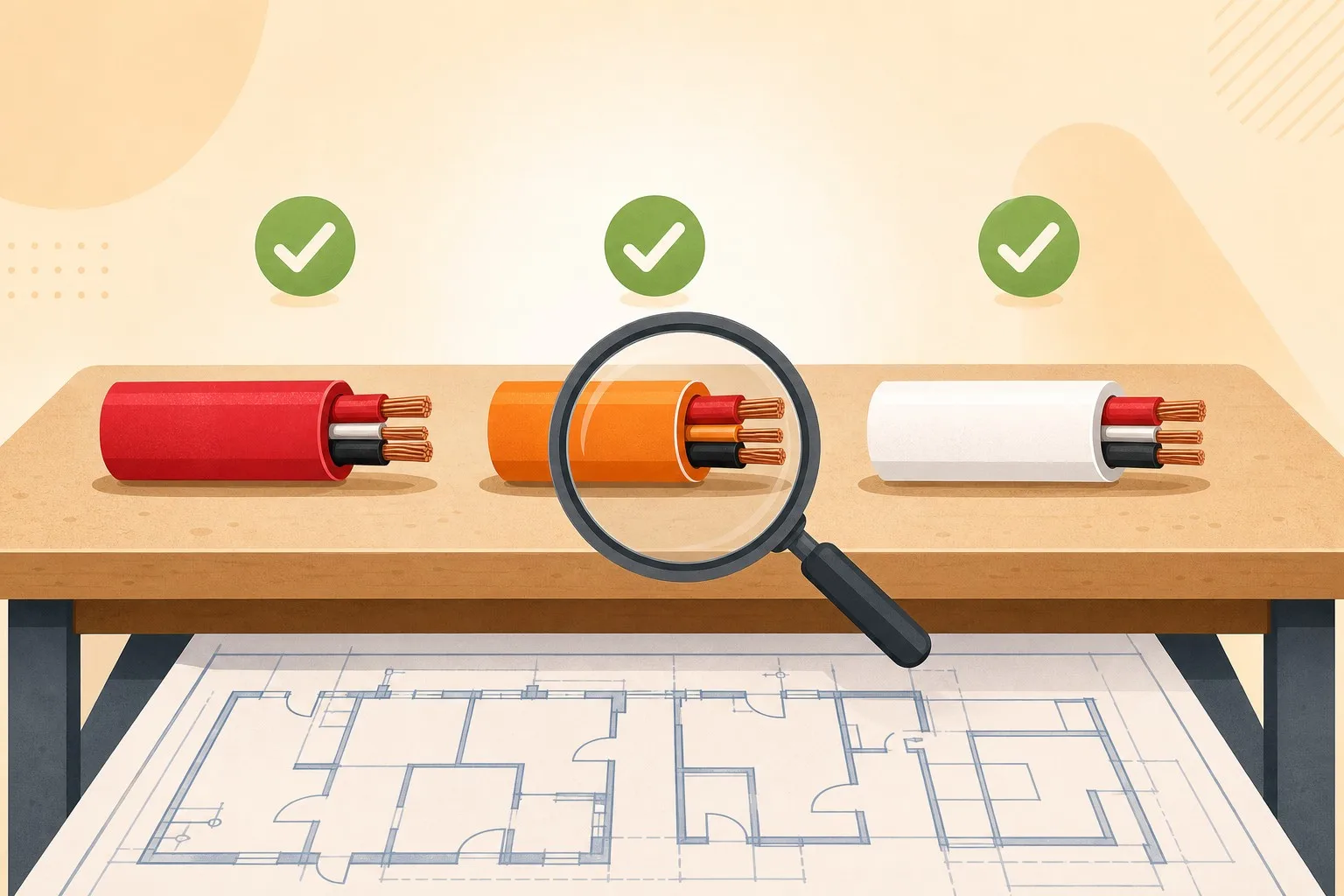
- Colour — red is the recognised colour for fire alarm circuits, making life-safety cabling easy to identify; white or orange are used where the design or local convention requires.
Typical electrical characteristics to check on the datasheet: rated voltage 300/500 V, test voltage 2,000 V, and the operating temperature range (a common range is -30°C to +180°C for fire-resistant constructions).
04 — Consider the Installation Environment
The route the cable takes decides several specification details that are easy to miss:
- General areas — standard fire-resistant cable is suitable for most indoor routes.
- Risers and shafts — in the US system, FPLR (riser-rated); in Europe, confirm the required CPR class for vertical runs.
- Plenums / air-handling spaces — FPLP (plenum-rated, low smoke) in the US; in Europe this is where CPR class and low-smoke performance matter most.
- Outdoor, buried or mechanically demanding routes — specify armoured fire-resistant cable (e.g. to BS 7846) or the manufacturer's outdoor-rated construction, and check the temperature range for the environment.
- Segregation — BS 5839 recommends keeping fire alarm cables separated from other services — generally 300 mm from power and data cables unless barriers or partitioned trunking are provided. This prevents electrical faults and interference from affecting alarm circuits.
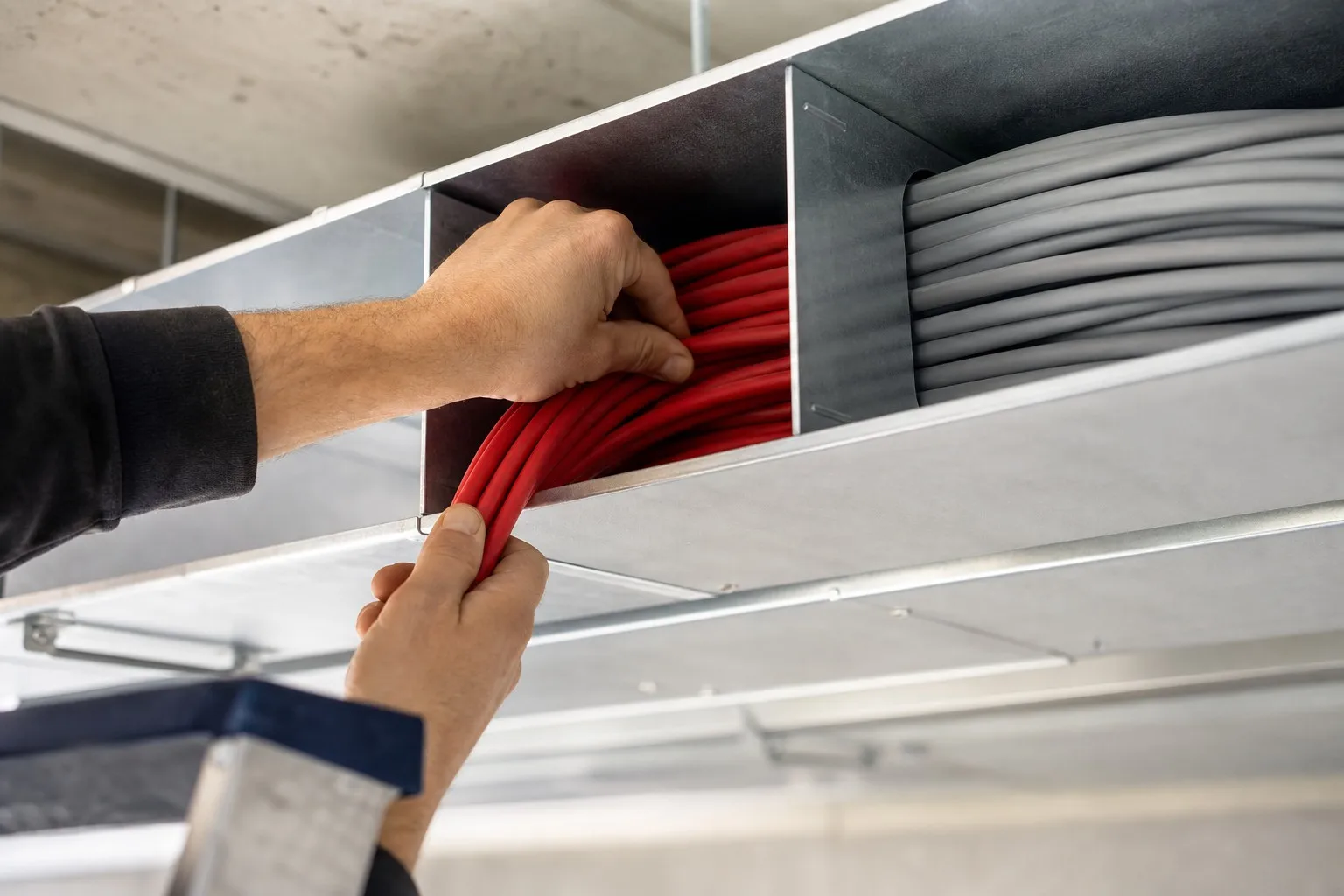
Also remember that joints matter as much as cable: terminations, junction boxes and supports used on fire alarm circuits should themselves be fire-resistant, because a weak joint breaks circuit integrity even if the cable is perfect.
05 — Verify Certification and Markings
A cable is only as good as the certification behind it. Before ordering, verify:
- Ask for the file number or certificate — for UL Listed cable, the E-file number (E + six digits); for Europe, the CPR DoP (Declaration of Performance) stating the Euroclass (e.g. Cca-s1a,d0,a1); for the UK market, LPCB or equivalent third-party approvals.
- Check the database — UL listings can be verified free of charge in UL Product iQ by company name, file number or category. For CPR, the DoP must trace to a notified body where applicable.
- Read the jacket legend — a genuine listed cable prints its type (e.g. "FPLR" or the PH rating), the standard reference and the manufacturer's file number on the sheath.
- Beware of red flags — a mark without a file number, a supplier who cannot produce one, a file number that does not resolve, or a certificate covering a different product category than the one offered.
06 — Balance Cost, Supply and Consistency
- Cost — standard-grade (PH30) cable is the economical default; enhanced grade costs more and should only be specified where the fire strategy demands it. Compare like-for-like: the same cores, size and certification.
- Supply — confirm MOQ, lead time, drum/coil lengths and packaging with the manufacturer before quoting. Fire alarm projects run to fixed installation schedules — delivery reliability is part of the specification.
- Consistency — use the same grade and type throughout the system. Mixing cable types creates weak points and complicates verification for the inspector.
- Traceability — keep batch records and certificates with the installation file; they are needed for commissioning and for future audits.
07 — Quick Selection Checklist
FAQ
Q: What size fire alarm cable do I need? A: BS 5839 requires copper conductors of at least 1.0 mm²; 1.5 mm² is the most common choice. On long circuits, check voltage drop and loop impedance and size up if needed.
Q: Do I need screened (shielded) fire alarm cable? A: Not always — but yes when the cable runs alongside power cables or in high-EMI environments, or when the system design calls for it. Screening prevents induced noise that can cause false alarms or missed signals.
Q: Can I mix standard and enhanced cable in one system? A: It is best practice to use the grade the design specifies for the whole system. A fire alarm network is only as strong as its weakest circuit — mixing grades creates weak points and complicates inspection. When in doubt, follow the system designer's specification.
Q: What is the CPR class and why does it matter for European projects? A: Under the EU Construction Products Regulation, installed cables need a Declaration of Performance and a fire-performance Euroclass (Aca to Fca). Fire-resistant cables for life-safety applications are commonly specified at Cca or better (e.g. Cca-s1a,d0,a1), which adds low smoke and low droplet criteria. Verify the DoP before supplying to EU projects.


 PH30 Red 2 Core Solid Fire Ala
 PH30 Red 2 Core Stranded Fire
  8 Core Stranded Shielded Secur
 Red Single Core 4mm 6mm 10mm S
 RVVP Power Cable
 2 Core Solid Blasting Cable
 Red and Transparent Flat Speak
 Flat 6 CoreTelephone Cable
 Flat 4 CoreTelephone Cable
 3mm double core steel nose wir
 Cat5E UTP Patch Cord
 Cat6 FTP Patch Cord